
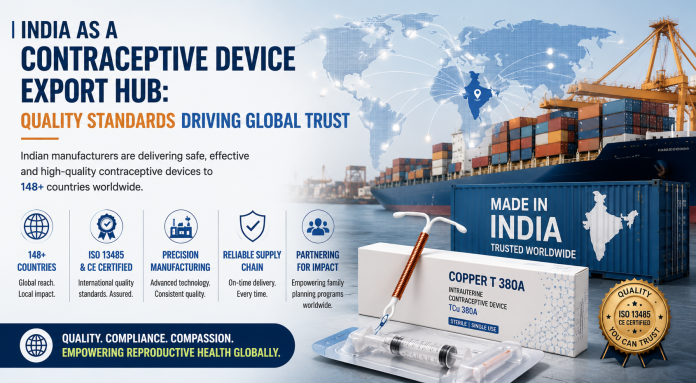

When procurement officers in Lagos, Lima, or Lahore source intrauterine devices for their national health programs, a growing share of those shipments begin their journey in India. This is not accidental. Over the past two decades, India has systematically positioned itself as a world-class hub for contraceptive device manufacturing combining rigorous international quality certifications, cost-competitive production, and a scale that few countries can match.
Today, IUD manufacturers in India export to over 148 countries, supplying copper IUDs, insertion kits, and ancillary instruments to national family planning programs, NGOs, UNFPA-led procurement initiatives, and private clinics worldwide. Understanding what drives this trust and what quality benchmarks separate reliable suppliers from the rest is essential reading for any clinician, procurement specialist, or public health administrator making sourcing decisions.
The Rise of India’s Contraceptive Manufacturing Sector
India’s contraceptive devices market is valued at approximately USD 264 million in 2025, projected to grow at a CAGR of 7.42% through 2030. But domestic consumption tells only part of the story. India’s real leverage lies in exports.
From Pharma to Medical Devices: A Manufacturing Legacy
The country has long been a trusted source for pharmaceutical generics exporting medicines to 191 countries with 50% of that output going to highly regulated markets like the US and Europe. The same manufacturing discipline has carried over into medical devices. Copper T manufacturers in India have invested heavily in cleanroom production, precision winding systems, and regulatory compliance frameworks that meet the most demanding international standards.
Growing Visibility in Global Procurement Registers
What has changed in the last five years is visibility. Global health programs increasingly document their supplier base, and Indian manufacturers now appear prominently in UNFPA procurement registers, WHO prequalification discussions, and bilateral health aid programs.
Quality as the Non-Negotiable Entry Ticket
Not every manufacturer from India earns global procurement contracts. The differentiator is certification depth.
ISO 13485:2016 The International Quality Benchmark
ISO 13485:2016 is the international quality management system standard for medical device manufacturing. It mandates traceability, risk-based process controls, post-market surveillance, and documented validation for every step from raw material sourcing to final packaging. Without it, WHO, UNICEF, and most national health ministries will not engage a supplier.
CE Marking The European Regulatory Gate
CE marking is equally critical for markets in the European Economic Area and many countries that align their regulatory frameworks with EU standards. Obtaining CE certification requires a notified body to audit both the quality management system and the technical documentation of each device.
Dual Certification as a Global Trust Signal
Leading IUD manufacturers in India that carry both ISO 13485 and CE certifications have effectively pre-cleared two of the highest regulatory bars in the world. This dual certification signals that a manufacturer’s processes meet the same standards demanded of European and North American device makers, at a fraction of the landed cost.
What Sets Indian IUD Manufacturing Apart: Technical Differentiators
Beyond certifications, technical manufacturing choices determine product performance.
Copper Winding Precision
Copper winding precision is one of the most consequential factors in IUD efficacy and safety. A double-winding system where copper wire is wound in a manner that eliminates wire protrusion and prevents overlapping outperforms single-winding systems by reducing the risk of sharp wire ends that can cause patient discomfort or tissue injury. This engineering detail, invisible at the point of insertion, separates clinical-grade IUDs from commodity production.
Material Compliance and Specifications
Material compliance is another area where serious Copper T manufacturers in India distinguish themselves. Frames composed of verified low-density polyethylene and barium sulphate compounds, copper wire certified at 99.99% OFE (oxygen-free electronic) purity, and Mylar-Mylar film sterile packaging that meets shelf-life and sterility requirements these specifications matter to the gynecologist inserting the device and to the patient relying on it for up to ten years.
Ancillary Components: Luer Lock Syringes and Insertion Kits
Luer lock syringe manufacturers in India and disposable syringe manufacturers in India supplying IUD insertion kits face the same scrutiny. A sterile, single-use 2ml luer lock syringe that fails during a procedure is not an abstract quality failure it is a clinical event with real patient consequences. The best Indian manufacturers apply the same ISO 13485 rigor to ancillary products as they do to primary devices.
The Content Gap No One Is Filling: Procurement Intelligence
Most published content about Indian medical device exports focuses on macroeconomic market size or high-level regulatory frameworks. What is largely absent is actionable procurement intelligence the specific quality signals that distinguish a world-class supplier from one whose certifications are in order but whose process controls are not.
Five Questions Every Procurement Officer Should Ask
Clinicians and procurement officers evaluating IUD manufacturers in India should ask:
- Is the ISO 13485 certificate scope-specific to IUDs, or does it cover unrelated product lines that inflate the audit scope?
- Has the manufacturer completed independent clinical studies on their specific IUD models not just relied on WHO data for the TCu 380A design generically?
- What is the manufacturer’s post-market surveillance protocol? Are adverse events tracked, reported, and fed back into process improvement?
- How is copper surface area verified per batch? Is it tested or assumed from design specifications?
- Does the factory offer custom product configuration sizes, copper loads, loading device options to meet the specific requirements of different markets?
These are the questions that separate a procurement decision grounded in quality from one grounded in price alone.
India’s Role in Closing the Global Contraception Gap
Approximately 218 million women in low- and middle-income countries have an unmet need for modern contraception. For national health programs trying to close that gap on constrained budgets, Indian-manufactured copper IUDs represent a critical supply option effective, hormone-free, long-lasting, and economically accessible.
Market Trajectory and Export Capacity
The India contraceptive devices market is expected to reach USD 377.61 million by 2030, a trajectory underpinned by both domestic demand growth and expanding export capacity. As long-acting reversible contraceptives gain policy priority globally, the manufacturing base that supplies them reliably will determine program outcomes for millions of women.
Conclusion
India’s emergence as a leading contraceptive device export hub is built on a foundation of international quality certification, engineering precision, and demonstrated clinical safety. For clinicians evaluating suppliers, procurement officers sourcing for national programs, and NGOs managing reproductive health supply chains, the key is looking past market position and asking the right quality questions. The manufacturers who can answer them with documented evidence, not marketing claims are the ones worth partnering with